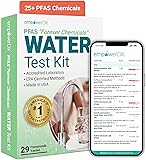
PFAS Water Tests Are Important

PFASPFAPFASPFAS water test can indenity what is in your drinking water and what to do about it

Most Americans do not know whether their drinking water contains PFAS. If you are on a public water system, federal data is available to check. If you have a private well, no one is testing it for you. This page walks you through both situations, explains what a PFAS water test measures, and tells you how to interpret your results.

Do You Need a PFAS Water Test?

The answer depends on your water source and what data already exists for your area.

If you are on a public water system

Public water systems serving 3,300 or more people were required to test for 29 PFAS compounds under EPA’s Unregulated Contaminant Monitoring Rule 5 (UCMR5), which ran from 2023 to 2025. Results are publicly available. Before you pay for a home test, check what your utility has already found.

Search the EWG Tap Water Database at ewg.org/tapwater with your zip code. You can also access raw UCMR5 data at epa.gov/dwucmr or request your utility’s most recent Consumer Confidence Report directly.

If your system detected PFAS above EPA MCLs, your utility is required to notify you. If you have not received notification and your water shows contamination in the EWG database, request written confirmation from your utility and ask what treatment is planned.

A home PFAS water test for public water users is still an option if you want confirmation at your specific tap, want to test water after your filter, or if your utility is small and may not have been covered by UCMR5 requirements.

If you have a private well

Private wells are not covered by any federal PFAS testing requirement. No federal agency is monitoring your well. If your well is contaminated, you will not know unless you conduct a PFAS water test.
Private well testing for PFAS is strongly recommended if any of the following apply to you:

  • You live within a few miles of a military base, airport, or industrial facility that has used or manufactured PFAS
  • You live near a landfill where PFAS-containing products or AFFF stocks have been disposed
  • You live near farmland where municipal biosolids (sewage sludge) have been applied as fertilizer — biosolids frequently contain PFAS
  • Your neighbors or local news have reported PFAS contamination nearby
  • You have pregnant women, infants, or young children in your household
  • You want a baseline measurement even with no known local contamination
State programs for private well owners

Several states offer free or subsidized PFAS testing for private well owners in areas near known contamination. Michigan, Minnesota, New Hampshire, Vermont, and others have active programs. Contact your state environmental agency to ask what is available before paying for a test. See our Your Rights page for state agency contacts.

What PFAS Tests Measure

Not all PFAS water tests are the same. Understanding what a test covers helps you choose the right one and interpret results accurately.

Test Type

Compounds Covered

Typical Cost

Best For

EPA Method 533

25 PFAS compounds (short-chain and long-chain)

$150–$400

The most comprehensive standard test. Covers the six compounds subject to EPA MCLs plus many others. Recommended as first choice for private wells.

EPA Method 537.1

18 PFAS compounds (primarily long-chain)

$100–$300

Strong coverage for the most-studied PFAS including PFOA and PFOS. Misses some short-chain compounds. Widely available from certified labs.

TOP Assay (Total Oxidizable Precursor)

Estimates total PFAS including precursor compounds

$300–$600

Research-grade test that measures PFAS the standard methods miss. More useful for detailed site investigations than routine consumer testing.

Rapid home screening kits

Limited panel, typically 6–14 compounds

$40–$150

Quick preliminary screening only. Not sufficient for regulatory purposes. Results should be confirmed with certified lab testing if PFAS are detected.

Which PFAS water test to choose

For most private well owners, EPA Method 533 from a state-certified laboratory is the best starting point. It covers the widest range of PFAS at a reasonable cost and produces results that are admissible for regulatory and legal purposes. If you are near a military base or industrial site, your state environmental agency may specify which test method they require for formal complaints.

How to Conduct a PFAS Water Test

1

Check publicly available data first. Before ordering a test, search ewg.org/tapwater with your zip code. If you are on a public system and results are already available, you may not need to test at all — or you will know exactly what to look for.

2

Find a state-certified laboratory. Use the EPA’s database of certified drinking water laboratories at epa.gov/dwlabcert. Only certified labs produce results usable for regulatory, legal, or insurance purposes.
Your state health or environmental department may also maintain its own list of certified labs.

3

Contact the lab and request a PFAS sampling kit. Specify EPA Method 533 or 537.1. The lab will send you certified sampling containers with instructions. Do not use your own containers — PFAS can leach from plastic, contaminating the sample.

4

Collect your sample correctly. Follow the lab’s instructions precisely. For tap water, most labs require you to flush the tap for 1 to 5 minutes before collecting the sample to get a representative draw from your distribution system. For well water, collect at the wellhead tap before any filtration or treatment.
If you want to test your water both before and after a filter, collect two separate samples and label them clearly.

5

Return the sample promptly. PFAS samples have holding times — typically 28 days for EPA Method 533. Ship the sample back to the lab as soon as possible after collection, ideally with overnight shipping.

6

Receive and interpret your results. Results typically arrive within 5 to 15 business days. The report will list each compound tested and the concentration detected, usually in parts per trillion (ppt) or nanograms per liter (ng/L), which are equivalent units.

Interpreting Your Results

PFAS water test results list each compound and its detected concentration in parts per trillion (ppt). Here is how to read those numbers against the current federal standards.

Below 4 ppt

Bioaccumulation

Your water meets the current federal standard. Whether to filter is a personal decision based on health situation and proximity to contamination sources.

4–10 ppt

Above PFOA/PFOS MCL, below others

Your water exceeds the EPA MCL for PFOA or PFOS. Filtration is strongly recommended. Report the result to your state drinking water agency.

Above 10 ppt

Above all current EPA MCLs

Significant contamination. Install a certified filter immediately. Do not use this water for drinking, cooking, or formula preparation until treated. File a formal complaint with your state agency.

The MCLG is zero for PFOA and PFOS

The EPA’s maximum contaminant level goal for PFOA and PFOS is zero — meaning the agency has determined there is no level at which exposure is risk-free. The MCL of 4 ppt is the lowest level technically achievable and enforceable, not a safety threshold. Some people choose to filter even when results are below the MCL, particularly if they have young children or are pregnant.

Understanding non-detects

A result reported as “ND” (non-detect) or “less than” a method detection limit means the lab did not find that compound at or above the level the instrument can reliably measure. It does not mean the compound is absent. Method detection limits for EPA Method 533 run from roughly 0.5 to 2 ppt depending on the compound and lab. PFAS below those levels would not appear in your results.

If multiple PFAS are detected

The EPA’s mixture rule applies when two or more of PFNA, PFHxS, HFPO-DA (GenX), and PFBS are detected. In that case, a hazard index calculation applies even if each individual compound is below its own MCL. If you detect multiple PFAS, your lab report or state agency can help you determine whether the mixture rule is triggered.

What to Do With Your PFAS Water Test Results

If PFAS are detected above MCLs

Install a point-of-use reverse osmosis filter certified to NSF/ANSI Standard 58 at your primary drinking and cooking water source. Use filtered water for formula preparation. Report the result to your state drinking water agency — particularly if you are on a public system, since that utility may be in violation of federal law.

If you are on a private well, contact your state environmental agency. Ask whether your contamination level qualifies for state assistance programs, bottled water provision, or filter installation support. Several states fund these programs for private well owners near confirmed contamination zones.

If PFAS are detected below MCLs

Your water meets current federal standards. Whether to filter is a personal decision. The EPA’s MCLG of zero for PFOA and PFOS reflects the agency’s position that no level is without risk, so filtering below the MCL is a reasonable precaution — particularly if you have young children, are pregnant, or have other health considerations.

If no PFAS are detected

Your results show no PFAS above the method detection limit. This is the best result. Keep in mind that contamination levels can change, particularly near active industrial or military sites. Retesting every 2 to 3 years is reasonable if you have risk factors in your area.

Testing your filter’s performance

To verify a filter is working, collect samples from both before and after the filter at the same time. A functioning certified reverse osmosis system should reduce PFAS by 90 percent or more. If post-filter levels are not significantly lower than pre-filter levels, your filter media may be exhausted or improperly installed.

Filter Options if PFAS Are Found

Filter Type

PFAS Removal

Certification

Notes

Reverse Osmosis (under-sink)

Up to 94%

$150–$400

Most effective point-of-use option. Treats drinking and cooking water. Requires filter replacement every 6 to 24 months depending on model and water quality.

Activated Carbon (pitcher or faucet)

Moderate to high

NSF/ANSI 53

Effective for long-chain PFAS. Less effective for short-chain compounds. Replace filter cartridges on the manufacturer’s schedule — an overloaded carbon filter stops working.

Whole-house RO or ion exchange

High

NSF/ANSI 58

Treats all water entering the home. Significantly more expensive to install and maintain. Most appropriate for high contamination levels or households with large families.

Verify certification before you buy

Not all filters marketed as “PFAS-removing” have been independently verified. Look up any filter’s certification status at nsf.org before purchasing. Certification to NSF/ANSI Standard 58 means the filter has been tested and verified to reduce specific PFAS compounds to the levels claimed.

ForeverChemicals.info provides educational information for general consumers. Nothing on this site constitutes legal, medical, or environmental consulting advice. Testing costs are approximate and vary by region and lab. Verify current lab certification status through your state’s drinking water program or epa.gov/dwlabcert. Last updated February 2026.